About Us

The company is located in Montaldo Roero, in the province of Cuneo, where the Bertello family has been present since 1846, in the locality of Ciapetto (data found in land registry maps from 1623). In the Piedmontese dialect, “Ciapat” means “small isolated area of land.” And indeed, our farmhouse is the most isolated in the village, situated atop a hill on the border with the village of Monteu Roero.
The company, founded in 1850 by our great-grandfather, Giacomo Bertello, was originally a farm with small vineyards and orchards, dedicated to fruit and vegetable production and livestock farming. In particular, his son, Grandfather Antonio, believed in the potential of this splendid land and began to dedicate himself to grape production as well. He expanded the company and began to passionately vinify his own grapes in his small cellar, producing both bulk and bottled wine under his own label.
Our father Giacomo and his brother, Uncle Piero, always lent a hand in the company as a second job, until they took over the situation upon Grandfather Antonio’s death. It was Giacomo who chose to leave his permanent job to dedicate himself completely to the company. By acquiring land and working hard, he expanded the business, focusing almost exclusively on the sale of wine, with a small portion dedicated to Piedmont Hazelnut PGI and seasonal fruit. Today, we have about 12 hectares of vineyards, ranging from the oldest, which reach 80/90 years of age, to the youngest, which are 5 years old.
The oldest vineyards are still worked almost entirely by hand today, as the steep slopes and narrow spacing between the rows make it impossible to enter with tractors. In the younger vineyards, soil cultivation and grass cutting are carried out with crawler tractors, while the harvest remains strictly manual for us.
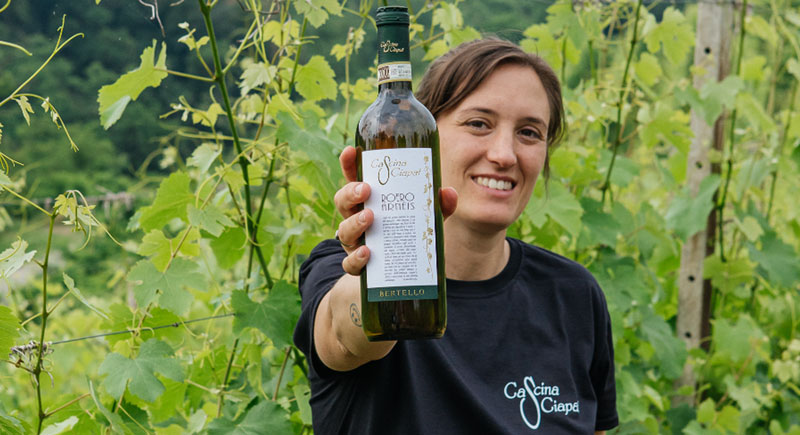
Today, it is we, Luca and Ilaria, who carry the company forward with pride, introducing our wines and products to all enthusiasts in the sector.

Cultivation: Organic Substances and Natural Elements
The geological profile of Roero is dominated by sand mixed with sandstone (a fragile sedimentary rock of marine origin, once used for construction and sculpture due to its softness and ease of processing), with abundant limestone and clay. The soils, rich in calcium, potassium, phosphorus, and various other microelements, combined with a good amount of organic matter with which we fertilize annually, make this land ideal for vine cultivation.
The terrain is generally very steep (in some vineyards we reach a mountain slope of 30%) and varies in color from yellowish to reddish.
Our vineyards extend for about 12 hectares and are located in the municipalities of Monteu Roero, Montaldo Roero, Vezza d’Alba, Baldissero d’Alba, and Corneliano d’Alba. The plots are quite fragmented and scattered across these municipalities. They occupy sandy soils and slopes with the best exposure, where the harshness of the hilly terrain does not always allow for the use of machinery, and work is still carried out manually according to ancient agricultural traditions. Terraced vineyards, rugged hills, and favorable exposures offer us our wines, the fruit of a land pervaded by marly and rocky formations, surrounded by green landscapes and a unique local microclimate, rich in typical characteristics.
The Most Historic Vineyards
The first vines were planted by the founder Giacomo and his son Antonio.
The historic Valmaggiore Nebbiolo vineyard, which boasts a 40% slope, was planted in 1943 and is located in the municipality of Vezza d’Alba. Characterized by steep slopes, it is still worked exclusively by hand today, producing Nebbiolo grapes that carry the “Vigna Valmaggiore” designation. We have a very strong bond with this vineyard because it was also planted by Giovanni, Grandfather Antonio’s younger brother, who was called to arms shortly after and of whom the family never heard again.
The Gargan and Pingiot vineyards, about 80 years old, are the vineyards surrounding the farmhouse that have always been owned by our family. Worked entirely by hand, they still produce Nebbiolo grapes that are the envy of all the neighbors! And from which we obtain Roero DOCG.
The Cagnòla vineyard, 70 years old, is a vineyard with a high slope and vertical rows. Here we produce Nebbiolo and Favorita. It is one of the vineyards with the best exposure.
A part of the Vallegiora vineyard, planted by Grandfather Antonio with his sons in the 80s, from which we obtain Nebbiolo grapes for our Rosato and Arneis grapes that excel for their quality.

In the last ten years, the number of vineyards has increased
Alongside the company’s historic vineyards are the younger ones, planted by Giacomo and Luca.
The Costabella vineyard, about 25 years old, where Barbera and Dolcetto are produced;
The Lunetta vineyard, about 20 years old, selected for the production of superior quality Arneis;
The Cisane vineyard, 15 years old, where Arneis and Nebbiolo are grown;
The Vallegiora vineyard. We expanded the existing vineyard by purchasing adjacent land. We now produce Arneis, Favorita, Nebbiolo, and Barbera throughout the vineyard;
The Centanito vineyard, planted in 2015, with its excellent production of Nebbiolo, Arneis, and Riesling.
“We are very proud of our vineyards and of being able to work these magnificent lands, because only by falling in love with them can we bring out their true value and their heritage, which is inimitable.”
LUCA BERTELLO
Cellar Work: Care for Aromas and Flavors
Luca, our enologist, meticulously supervises every stage of the process. He takes care of the wine with the same attention as a son, accompanying it from vinification to the bottle.
Each vineyard has different characteristics based on sun exposure, soil, slope, and age. To preserve the characteristics of each, we dedicate a specific tank to every vineyard.
Cellar work is very delicate, as it is necessary for us to bring out the primary aromas and flavors of the grapes and ensure they are maintained over time.
The main phase of the process takes place in the cellar: the grapes are transformed into wine through vinification. Pressing varies depending on the color of the grapes: white grapes are vinified without skins, while red grapes are left to ferment with the must.
The first fundamental phase in the cellar is alcoholic fermentation, in which the sugars present in the grapes are transformed into alcohol.
“My most beautiful childhood memories are here, in our farmhouse. Here I bottled and labeled my first bottles by hand with Grandfather Antonio, and crated apricots with Grandmother Caterina. Today, carrying on our tradition is an invaluable fortune for me.”
ILARIA BERTELLO
PUMP-OVERS
For red wines, pump-overs are necessary to allow the color, aromas, and tannins to emerge from the skins and express themselves in the final wine.
The skins, being lighter, tend to form a sort of “cap” on the surface of the wine. Thanks to pump-overs, the skins are kept in contact with the must, extracting the organoleptic characteristics that will define the wine.
THEN
After the pump-over and alcoholic fermentation, the must is now considered wine and is thoroughly separated from the skins through pressing.
The must is then poured into a new tank, while the remaining solid part, known as pomace, is delivered to the distillery to produce grappa.
FINALLY
The wine is racked into stainless steel tanks to again eliminate the last solid part that continues to settle and could ruin the wine with organoleptic defects. Before bottling, it is filtered with special cellulose filters.
Vineyard Work by Season
Autumn
To promote conservation and fertility, the rows are tilled and fertilized with organic fertilizer after the harvest, an essential operation to obtain quality grapes and maintain a good vegetative-productive balance among the vines.
Winter
During the winter, the vines rest. From December to March, pruning is carried out, leaving a single shoot, which will be the parent of the grapes that will grow the following year.
Spring
Finally, the new shoots appear!
The preserved branches are tied to wires to align them horizontally. In April, we begin green pruning, eliminating all shoots on the old wood, as these do not produce grapes but consume a lot of the plant’s energy.
These steps are essential to keep the new shoots straight and well-spaced.
Summer
Between May and August, treatments are carried out along with grass cutting between the rows.
At the end of July, we begin thinning out excess or greener clusters. This serves to provide more nourishment to the remaining clusters.
The old vineyards are not accessible by tractor, so all work is carried out by hand, including grass cutting which is done with a brush cutter.
Again… Autumn
Now everything is ready for the harvest!
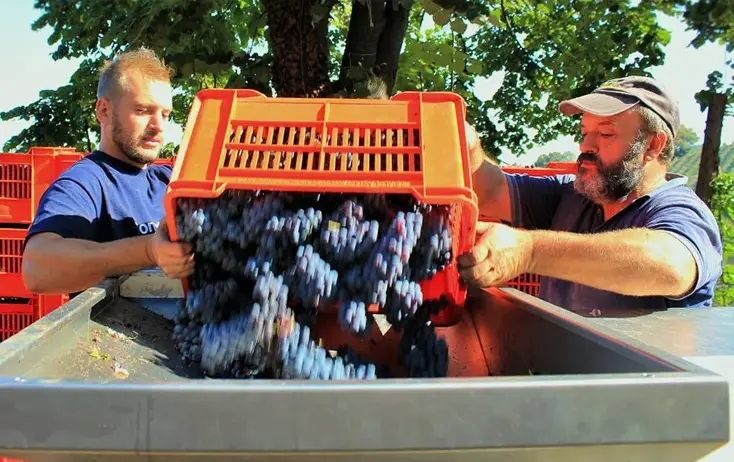
Harvesting begins in mid-September with the white grapes of Arneis, Favorita, and Riesling, and ends in late October with the harvest of the last Nebbiolo.
“Leaving my permanent job, almost 30 years ago now, was a gamble. I have never regretted it, despite the most difficult moments and decisions. Today I am proud of our work and of the high-quality product we obtain thanks to it.”
GIACOMO BERTELLO
Staff
Giacomo and Piero
Giacomo:
A tireless person, always with a thousand ideas for his business, he spends the entire day in the vineyards; he takes care of them as if they were his children. He leaves the house at 6:30 in the morning and doesn’t show up before 9:00 PM!
Piero
A kind and generous man who works incredibly hard. His life is divided between factory shifts and those at the company. He takes care of the health of the orchards, pruning and planting potatoes and onions.
Luca, Ilaria, and Marinella
Luca:
A graduate of the Enological School of Alba, he strives to obtain the best wine the vineyard can offer every year. If you call him and he doesn’t answer, rest assured he is on the tractor in the vineyard!
Ilaria
Always kind and smiling. She handles reception, tastings, and order management. If there is a problem with an order, call her and she will do her best to help you!
Marinella:
Wife of Giacomo and mother of Luca and Ilaria. An energetic and always available person. She divides her
time between being a grandmother and helping at the farmhouse.